
The Metaphysics of Imperfection
The history of computer graphics is a rebellion against sterile machine perfection. In early image synthesis, the digital universe consisted of immaculate Euclidean geometry, where surfaces were perfectly flat and lighting followed rigid mathematical laws absent of physical texture.
The result was an aesthetic pioneers termed the "machine look"—a technical realism that failed to capture the essence of the organic world. Overcoming this paradigm did not occur through brute computational power, but through a profound understanding of randomness. The development of Perlin Noise and the strategic utilization of Random Seeds permitted digital architects to introduce chance systematically, transforming raw chaos into algorithmic surprise.
Human perception is finely tuned to recognize patterns, yet highly sensitive to structural absence. Confronted with White Noise, the visual cortex experiences cognitive fatigue translated into an aesthetic judgment of artificiality. White noise distributes energy equally across all frequencies; each pixel is statistically independent of its neighbors, triggering cognitive interruption as the brain attempts constant, exhaustive reorientation.
Spectral Properties of Noise
Organic environments project "organized density." A forest is dense with visual data but rarely perceived as "noisy" because its structure is arranged in continuous fields of scale. Mathematical models categorize noise by frequency distribution.
| Noise Type | Spectral Characteristic | Cognitive Effect |
|---|---|---|
| White Noise | Equal power across all frequencies. | Harsh, static, cognitively exhausting. |
| Pink Noise (1/f) | Power inversely proportional to frequency. | Balanced, natural, biologically resonant. |
| Perlin Noise | Smooth, coherent gradient interpolation. | Fluid, organic (Terrain, Clouds, Textures). |
[ TOPOGRAPHY_GENERATION_SIMULATOR ]
Compare pure stochastic chaos against coherent spatial continuity.
Function: Multi-octave interpolated scalar field (n=4).
Correlation: 1.0 (Local spatial continuity).
[ STATUS ] Organized density. Topographical landscape successfully generated.
The Genesis of Organized Chance: Tron (1982)
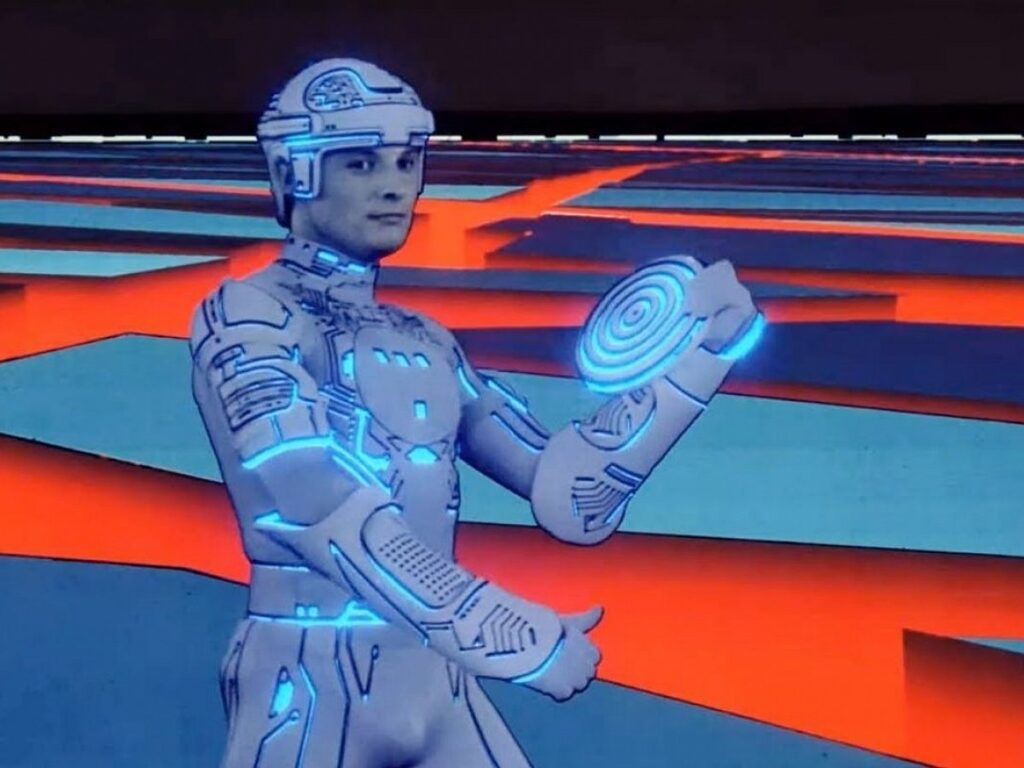
In 1982, Ken Perlin, a computer scientist at the Mathematical Applications Group (MAGI) working on Disney's Tron, recognized that existing tools modeled polygonal structures effectively but failed completely at simulating moss, leaf veins, or fire turbulence.
Perlin engineered an image synthesizer to generate procedural textures via a controllable noise function. Perlin Noise was born from the practical necessity to inject organic imperfections into digital surfaces without consuming prohibitive amounts of memory. Perlin received a Technical Achievement Academy Award in 1997 for this breakthrough.
The Mathematical Architecture of Gradient Noise
Unlike simple Value Noise, which interpolates between random points, Perlin noise is a gradient noise. It defines an n-dimensional space divided into a cellular grid. At each grid node, a random unit vector is assigned via a permutation hashing scheme.
A critical aspect of this architecture is the interpolation function. Perlin initially utilized the smoothstep function $s(t) = 3t^2 - 2t^3$. However, this caused visible artifacts in the noise derivative affecting surface shading. In 2002, he introduced an improved fifth-order polynomial: $s(t) = 6t^5 - 15t^4 + 10t^3$. This ensured that first and second-order derivatives reach zero at cell boundaries, guaranteeing perfectly smooth transitions and eliminating sudden curvature jumps.
Fractal Complexity: Octaves and Lacunarity
Pure Perlin Noise visually resembles soft clouds. Transforming it into complex structures like mountain ranges requires octave accumulation, known mathematically as Fractal Brownian Motion (fBm). This algorithm superimposes noise layers governed by three parameters:
Octaves
The number of noise layers combined. Each successive layer adds finer detail to the topology.
Persistence
Determines amplitude decay per octave. High persistence creates rocky terrains; low persistence creates rolling hills.
Lacunarity
Controls the rate of frequency increase. Usually doubled per layer, generating progressively minute details.
Simplex Noise: Overcoming the Cubic Grid
Classic Perlin Noise scales poorly at $O(2^n)$ complexity, making it computationally heavy in higher dimensions. It also exhibits "axis alignment," causing patterns to visibly align with the underlying grid. In 2001, Perlin introduced Simplex Noise.
Simplex utilizes simplicial grids (triangles in 2D, tetrahedrons in 3D) instead of hypercubes. Interpolation nodes drop from $2^n$ to $n+1$, drastically reducing load in 4D while producing visually isotropic (rotationally uniform) noise. Patent restrictions birthed open-source alternatives like OpenSimplex, now standard in modern engines.
The Seed of the World: Determinism and Agency
If noise is the raw material of organized chaos, the Random Seed is its fingerprint. Computers utilize Pseudo-Random Number Generators (PRNGs)—purely deterministic functions that output the exact same "random" sequence given the same initial seed.
In architectural games like Minecraft or No Man's Sky, entire planets are not stored on disk; they are generated in real-time. Two players separated by continents can explore identical topographies without transmitting a single byte of terrain data, because the environment is the deterministic output of $f(x, y, z, seed)$.
Conclusion: The Persistence of Algorithmic Surprise
The Architecture of Chance is not about the absence of order; it is about extracting the higher-order complexity inherent in nature. From Ken Perlin's 1980s experiments to modern infinite universe generation, coherent randomness remains the foundational element providing "soul" to the digital construct.
White noise represents a cognitive barrier, interrupting spatial comprehension. Gradient noise and deterministic seeds provide the exact balance: the stability required for architectural simulation and the variance required for aesthetic beauty. By mastering these parameters, the digital creator transcends static modeling, architecting dynamic ecosystems where surprise is an algorithmic feature rather than a system error.
>> Bibliographic_References.log
- [01] Perlin, K. (1985). An Image Synthesizer. SIGGRAPH Computer Graphics.
- [02] Perlin, K. (2001). Noise Hardware. Real-Time Shading SIGGRAPH Course Notes.
- [03] Perlin, K. (2002). Improving Noise. ACM Transactions on Graphics.
- [04] Ebert, D. S. et al. (2003). Texturing & Modeling: A Procedural Approach.