Theoretical Foundations of Artificial Life
The synthesis of life within artificial mediums is not merely a technological curiosity; it is an effort to decode the organizational logic separating inanimate matter from biological systems. The field of Artificial Life (ALife) proposes that "aliveness" resides not in carbon substrates, but in information processing and complex system dynamics.
By abstracting reproduction, mutation, and evolution into the computational domain, researchers explore "life as it could be," freeing theoretical biology from the constraints of the terrestrial biosphere. ALife adopts a bottom-up approach, where complex global behaviors arise from local interactions between simple components.
The defining characteristic of these systems is emergence. This concept describes properties or behaviors not explicitly programmed by the creator, but which arise through recursive feedback loops. For a digital system to be considered "alive" (or possessing "lyfe"), it must exhibit energy dissipation, autocatalysis, homeostasis, and learning.
Carbon vs. Silicon Substrates
| Characteristic | Terrestrial Biology | Digital Organisms |
|---|---|---|
| Substrate | Carbon Macromolecules | Computational Code / Silicon |
| Replication | Cellular Division / DNA | Code Replication / String Writing |
| Variation | Genetic Mutation / Recombination | Bit-flipping / Algorithmic Stochasticity |
| Metabolism | Redox Chemical Reactions | CPU Cycles / Memory Consumption |
Cellular Automata and the Game of Life
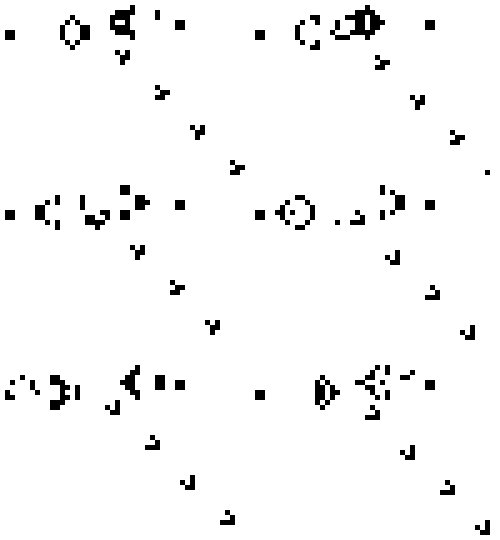
Cellular automata (CA) represent one of the purest forms of complex system simulation. A CA consists of a grid of cells, each in a finite state, evolving in discrete time steps following strict local rules based on immediate neighbors. The most influential model is John Horton Conway's Game of Life (1970).
Despite the simplicity of its rules (Survival, Death by Isolation, Death by Overpopulation, Reproduction), the system possesses the power of a universal Turing machine. These rules generate "deterministic chaos." The fragility of these patterns is notable; altering a single bit can cause complex structures to explode or collapse, mirroring the sensitivity to mutations in biological organisms.
[ EMERGENT_STRUCTURES ]
Lindenmayer Systems: Plant Grammar
While cellular automata focus on population dynamics, L-Systems offer an axiomatic base for morphogenesis and branched structures. Proposed by biologist Aristid Lindenmayer in 1968, they use formal grammars to describe plant growth via string rewriting, rendered through Turtle Graphics. Execute the algorithm below to observe procedural morphogenesis.
// FRACTAL PLANT AXIOMS
 Axiom: X

 Rules:

 X → F+[[X]-X]-F[-FX]+X

 F → FF

 Angle: 25.0°
Reaction-Diffusion: Turing Patterns
If L-Systems explain morphology, reaction-diffusion theory explains the chromatic patterns of nature. In 1952, Alan Turing proposed that complex patterns like zebra stripes emerge from the interaction of chemical substances reacting and diffusing through tissue.
The Turing model relies on diffusion-induced instability involving an activator (which stimulates its own production) and an inhibitor (which suppresses the activator). The Gray-Scott model computationally simulates these phenomena, transitioning between stable equilibrium and labyrinthine structures mimicking fingerprints and coral.
Biocybernetics and Kinetic Art
The intersection of biology and technology transcends pure simulation, manifesting in installations exploring the materiality of information. Kinetic art utilizes movement as a primary language, creating mechanical organisms.
- Theo Jansen's Strandbeests: Wind-powered tubular structures utilizing evolutionary algorithms to optimize mechanical proportions for fluid walking.
- Rafael Lozano-Hemmer: Utilizing biometric sensors to capture visitor heartbeats, transforming human vital rhythms into the engine for large-scale light and sound installations.
Conclusion: The Convergence
Exploring digital organisms reveals that life's complexity is not an impenetrable mystery, but the result of simple, recursive mathematical rules. From Game of Life's universal computation to L-Systems encoding forest architecture, information is the fundamental substrate.
The future lies in "open-ended evolution," where artificial systems develop novel survival strategies in response to dynamic virtual environments. By merging engineering precision with biological adaptability, biocybernetics paves the way for regenerative design, blurring the distinction between natural and artificial complexity.
>> Bibliographic_References.log
- [01] Conway, J. H. (1970). The Game of Life. Scientific American.
- [02] Lindenmayer, A. (1968). Mathematical models for cellular interactions in development.
- [03] Turing, A. M. (1952). The Chemical Basis of Morphogenesis.
- [04] Mitchell, W. J. T. (2003). The Work of Art in the Age of Biocybernetic Reproduction.
- [05] Ray, T. S. (1991). An approach to the synthesis of life. Artificial Life II.