> CRITICAL_LAB // AESTHETICS_OF_FAILURE
Process: Deconstructing the architectural illusion of seamless interfaces.
The Magnet and the Television
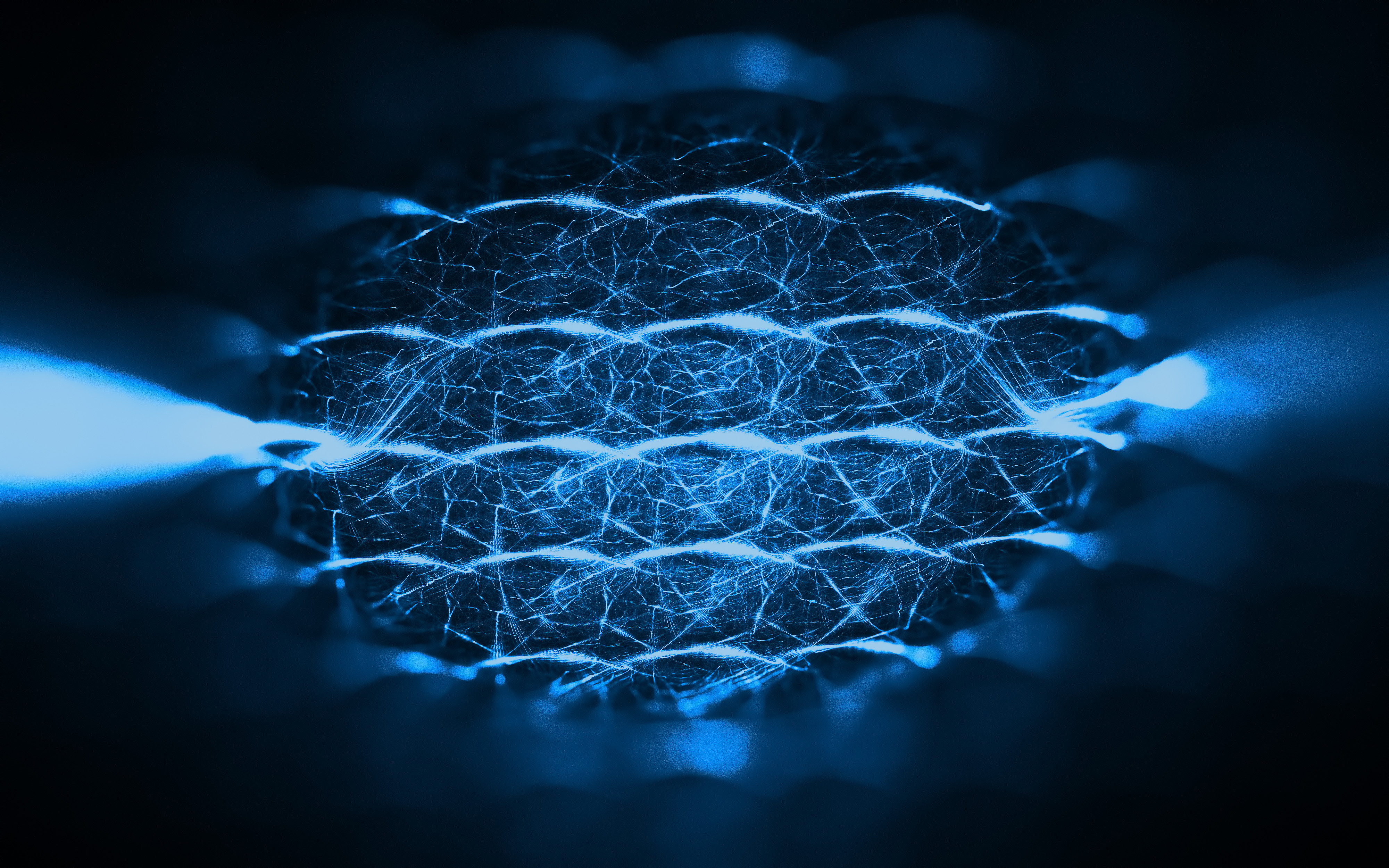
In 1963, Korean-American artist Nam June Paik held a large industrial magnet against the cathode ray tube of a television set during a live broadcast at the Galerie Parnass in Wuppertal, Germany. The electromagnetic interference warped the scanning electron beam, distorting the received video signal into undulating, organic abstractions that no human hand could have drawn.
The audience was horrified. They were watching the deliberate sabotage of a machine that was, at the time, the most sacred object of the Western domestic interior. Paik was not fixing the television. He was not breaking the television. He was revealing the television, exposing the electromagnetic infrastructure that existed beneath the surface of every broadcast, every commercial, every political speech.
This single gesture (the collision of a permanent magnet against a CRT phosphor screen) is widely recognized as the origin of glitch art. But to call it "art made with errors" misses the point entirely. What Paik demonstrated was that the error was always already present. The machine was always capable of producing these shapes. The signal was always this fragile. The only thing that changed was our willingness to look at the seams.
1. A Taxonomy of Failure
Rosa Menkman, the Dutch theorist and artist who wrote The Glitch Moment/um (2011), distinguishes between two fundamentally different categories of glitch practice:
01 Pure Glitch
The unplanned, unreproducible accident. A JPEG that decodes incorrectly due to a corrupted sector on a hard drive. A video stream that tears because a packet was dropped mid-transfer. The pure glitch is, by definition, ephemeral: once the system recovers, the artifact disappears forever. It cannot be exhibited. It can only be witnessed.
02 Glitch-alike
The deliberate, reproducible simulation of failure. An artist who opens a JPEG in a hex editor and manually inserts incorrect byte sequences. A programmer who writes a pixel-sorting algorithm that mimics the visual language of buffer overflows. The glitch-alike is the domesticated version of chaos: controlled, exportable, sellable.
This distinction matters because it reveals a paradox at the heart of the practice: the moment you intentionally create a glitch, it ceases to be an error. It becomes a design choice. The entire discipline exists in the tension between authentic system failure and its aesthetic reproduction.
2. The Technical Vocabulary
Every glitch technique maps to a specific layer of the digital infrastructure stack. Understanding which layer you are attacking determines the visual result:
Databending
Opening a media file (JPEG, BMP, WAV) in a text or hex editor and altering its raw byte data. The file header remains intact (the software can still open it) but the payload is corrupted. The result depends entirely on which bytes were altered and which codec interprets them. Databending a JPEG produces dramatically different artifacts than databending a BMP.
Pixel Sorting
An algorithmic process where rows or columns of pixels are extracted, sorted by a property (brightness, hue, saturation), and rewritten back into the image. The result is a characteristic waterfall effect: regions of the image dissolve into vertical or horizontal streaks of organized color.
Channel Shifting
Displacing individual color channels (Red, Green, Blue) along the X or Y axis. The human eye is exquisitely sensitive to chromatic misalignment, even a small pixel offset creates a visceral sense of wrongness. This technique directly references the analog phenomenon of color fringing in misaligned CRT television guns.
Datamoshing
Exploiting the structure of interframe video compression (H.264). By deleting keyframes and forcing the codec to apply motion data to the wrong reference image, the video smears: objects from scene A are dragged and morphed by the motion vectors of scene B.
Circuit Bending
The physical modification of electronic hardware. Jon Satrom and Reed Ghazala pioneered the practice of soldering new connections across circuit boards of consumer electronics (children's toys, video game consoles, synthesizers) creating unpredictable short circuits that generate new audiovisual behaviors. Unlike software glitch, circuit bending operates in the analog domain: the artifacts are electrical, not mathematical.
3. Benjamin, Fisher, and the Politics of the Broken Image
In The Work of Art in the Age of Mechanical Reproduction (1935), Walter Benjamin argued that the aura of a work of art (its unique presence in time and space, its authenticity) is destroyed by the ability to reproduce it endlessly. A photograph of the Mona Lisa is not the Mona Lisa. The copy lacks the aura of the original.
Glitch art inverts Benjamin's thesis entirely. The glitch creates aura through reproduction failure. A corrupted JPEG is, paradoxically, more unique than the original file, because the specific pattern of corruption can never be exactly replicated. The error reintroduces singularity into a medium defined by perfect duplication. Every glitch is an original.
Mark Fisher extended this logic into the domain of hauntology (a Derridean concept he repurposed to describe the cultural condition of being haunted by lost futures). In Ghosts of My Life (2014), Fisher argued that the crackle of a vinyl record, the tracking errors of a VHS tape, and the compression artifacts of early MP3s are not defects but temporal markers. They encode the distance between the present moment and the moment of recording. They remind us that the medium has a body, and that body ages.
Glitch art weaponizes this hauntological residue. When Rosa Menkman deliberately forces a video codec to produce macroblocking artifacts, she is not simulating nostalgia. She is making the codec's architecture visible. She is forcing the viewer to see the compression algorithms: the mathematical scaffolding that normally remains invisible behind the illusion of smooth, continuous motion.
This is why glitch art is inherently political. Every digital system (from JPEG to TCP/IP to the banking infrastructure) is built on layers of abstraction designed to hide their own complexity from the user. The user is not supposed to see the packet headers, the error correction codes, the lossy approximations. The interface is a mask. The glitch tears the mask off.
4. The Canon: Arcangel, Satrom, Menkman
Cory Arcangel is perhaps the most institutionally recognized glitch artist. His 2002 work Super Mario Clouds, a modified NES cartridge that displays only the scrolling cloud layer of Super Mario Bros. with all other game data erased, was acquired by the Whitney Museum of American Art. Arcangel's practice is surgical: he doesn't add noise; he subtracts signal. He removes layers of functionality until only the residue remains, exposing what the system looks like when stripped of its intended purpose.
Jon Satrom operates at the opposite end of the spectrum. His performances are chaotic, visceral, and often uncomfortable. Using custom-built software and circuit-bent hardware, Satrom generates real-time audiovisual feedback loops where the system's errors compound exponentially. His work embodies the pure glitch: the artist as facilitator of system failure rather than author of aesthetic output.
Rosa Menkman bridges practice and theory. Her Vernacular of File Formats (2010) is a systematic catalog of the visual artifacts produced by corrupting every major image format (JPEG, PNG, GIF, BMP, TIFF), documenting, for the first time, each codec's unique "failure signature." Menkman proved that corruption is not random: each file format breaks in predictable, characteristic ways determined by its compression algorithm. JPEG produces blocky DCT artifacts. PNG produces horizontal color displacement. RAW produces vertical banding. The error has a grammar.
5. Writing the Error: Pixel Sorting in JavaScript
The canonical pixel sorting algorithm reads a horizontal row of pixels, extracts their brightness values, sorts the array, and writes it back. The result is a controlled landslide of color, the image's chromatic data reorganized by mathematical order rather than spatial representation.
function pixelSort(imageData, w, h) {
  const data = imageData.data;

  for (let y = 0; y < h; y++) {
    // Extract row as array of {brightness, rgba} objects
    const row = [];
    for (let x = 0; x < w; x++) {
      const i = (y * w + x) * 4;
      const brightness = data[i] * 0.299
                       + data[i+1] * 0.587
                       + data[i+2] * 0.114;
      row.push({
        brightness,
        r: data[i], g: data[i+1],
        b: data[i+2], a: data[i+3]
      });
    }

    // Sort by luminance (ITU-R BT.601 standard)
    row.sort((a, b) => a.brightness - b.brightness);

    // Write sorted pixels back
    for (let x = 0; x < w; x++) {
      const i = (y * w + x) * 4;
      data[i]   = row[x].r;
      data[i+1] = row[x].g;
      data[i+2] = row[x].b;
      data[i+3] = row[x].a;
    }
  }
  return imageData;
}
Notice the brightness formula: R×0.299 + G×0.587 + B×0.114. This is the ITU-R BT.601 luma coefficient standard, the same formula used by analog television systems to convert color signals to grayscale. Even in our glitch code, the ghost of broadcast television persists.
A more sophisticated implementation would threshold the sort: only pixels above or below a certain brightness would be reordered, preserving recognizable features in the dark regions while dissolving highlights into liquid gradient. This is how Kim Asendorf's original Processing sketch operated, and it is exactly what the interactive engine below implements.
6. Interactive: The Glitch Engine
Every technique described in this article is implemented below as a real-time pixel manipulation pipeline. Upload your own image or use the default environment. Each slider controls one layer of the corruption stack. The effects compound, channel shift applied on top of pixel sorting produces results neither algorithm could achieve alone.
> Drag the sliders. Export the result as PNG.
7. The Infrastructure Made Visible
Every pixel on your screen is a lie agreed upon. The smooth gradient you see in a photograph is actually a staircase of discrete 8-bit values. The video you stream is not a continuous flow of frames, it is a sparse skeleton of keyframes padded with motion prediction vectors that your device reconstructs on the fly. The "cloud" where your files live is a windowless concrete building in Virginia consuming megawatts of electricity and cooling water.
Glitch art does not create errors. It reveals the errors that were always present, buried beneath layers of error correction, compression, and interface design. When you drag the Channel Shift slider above and watch the red layer separate from the blue, you are not adding an effect. You are removing the synchronization that normally hides the fact that your screen is, at every moment, painting three separate monochrome images on top of each other and praying that your eyes fuse them into one.
The glitch is not the exception. The glitch is the rule. The seamless image is the exception, a temporary, energy-intensive, computationally expensive truce between entropy and engineering. Every time that truce fails, even for a single frame, we catch a glimpse of the actual architecture of digital reality.
And that architecture, it turns out, is beautiful.
>> Bibliographic_References.log
- [01] Menkman, R. (2011). The Glitch Moment(um). Institute of Network Cultures.
- [02] Benjamin, W. (1935). The Work of Art in the Age of Mechanical Reproduction.
- [03] Fisher, M. (2014). Ghosts of My Life: Writings on Depression, Hauntology and Lost Futures. Zero Books.
- [04] Ghazala, R. (2005). Circuit-Bending: Build Your Own Alien Instruments. Wiley.