
> PROTOCOL_7 // LAIN_SYNC_ESTABLISHED
Theory & Aesthetic Synthesis: The Pre-Digital Trauma.
Introduction
The shift from biological corporealism to a networked existence represents the central anxiety of late 20th-century speculative media. Released in 1998, the television series Serial Experiments Lain functions as a prophetic diagnostic tool for understanding the psychological and structural implications of total connectivity.
While contemporary cyberpunk frequently prioritized the material aesthetics of cyberspace—neon-drenched urban decay, hyper-industrialized landscapes, and prosthetic enhancement—this series directed its focus toward the internal dissolution of consciousness into digital architectures. This is more than a change in medium; it represents a fundamental reconfiguration of the human subject.
The narrative trajectory suggests that the biological host is becoming a vestigial component of a broader, decentralized intelligence. By operationalizing theories of the cyborg, the simulacrum, and hauntology, the series maps the migration of identity from the localized physical body to the multiplexed expanse of the Wired.
The Ontological Dissolution Index
The transition from the physical to the digital is characterized by a steady erosion of biological priority. The series establishes a metrics-based understanding of this shift, where the relevance of the physical presence diminishes as the proxy in the Wired gains autonomy and influence.
Assimilation
The distribution of identity shown in the index suggests that the center of gravity for human experience has shifted to the network. This migration reflects the structural evolution into a decentralized entity. The physical world becomes a hologram, a secondary layer that merely contains the points of entry for the primary persistent reality of the network.
Haraway and the Post-Gender Cyborg: From Kusanagi to Lain
The conceptual framework of the cyborg, as articulated by Donna Haraway in 1985, provides a lens through which the character of Lain Iwakura can be understood as a post-biological evolution. Haraway defined the cyborg as a creature in a post-gender world, free from the traditional Western origin stories of unity and original innocence. Unlike the industrial cyborgs of the late 20th century, which often reinforced gender binaries through hyper-sexualized or hyper-masculinized prosthetic bodies, Lain represents an interpretation of the post-gender posthuman identity that bypasses these themes entirely.
The Subversion of Physical Binaries
In Ghost in the Shell, protagonist Major Motoko Kusanagi grapples with her cyborg existence within a physical, albeit manufactured, frame. Her identity is tied to the "ghost" within the "shell," yet she remains tethered to a humanoid form that guards the boundary of gender difference. Haraway's manifesto emerged from specific concerns including Reaganomics, Cold War politics, and the widening income gap, aiming to harness technology for liberation without upholding essentialist notions of womanhood. Lain operationalizes this by existing as a fragmented, constructed body/self that reflects the interconnected human experience. She is not a woman or a child in the traditional sense; she is a manifestation of the network.
The transition into the Wired allows Lain to become a chimerical entity—a hybrid of machine and organism where the distinction between the two is no longer relevant. Haraway argued that the cyborg has the potential to destabilize diametrically opposed categories: male and female, technology and nature, East and West. Because cyborgs subvert the boundary between machines and humans, they destabilize the structures of social reality.
The Myth of Original Unity
Haraway’s cyborg rejects the seductions of organic wholeness and the myth of original unity. This is mirrored in the revelation that Lain’s family and history are constructs—artificial narratives designed to ground her in a reality that she was never truly a part of. Her origin is not biological; she was born from the Wired, a personification of the network's burgeoning consciousness created through the interaction of millions of users acting as neurons. By accepting her nature as a decentralized entity, Lain fulfills the prophecy of a self that is untied from all dependency on Western humanist origin stories.
While some scholars criticize Haraway for a seemingly naive or optimistic view of technology's liberating potential, citing problems of surveillance and control, Serial Experiments Lain provides a more balanced critique. It shows that the cyborg identity is not just about liberation but also about the fragmentation of the self. The series depicts Lain splitting into multiple versions—the social one, the omniscient one, the angry one—reflecting the way digital systems copy and multiply the self.
Baudrillard and the Precession of the Wired
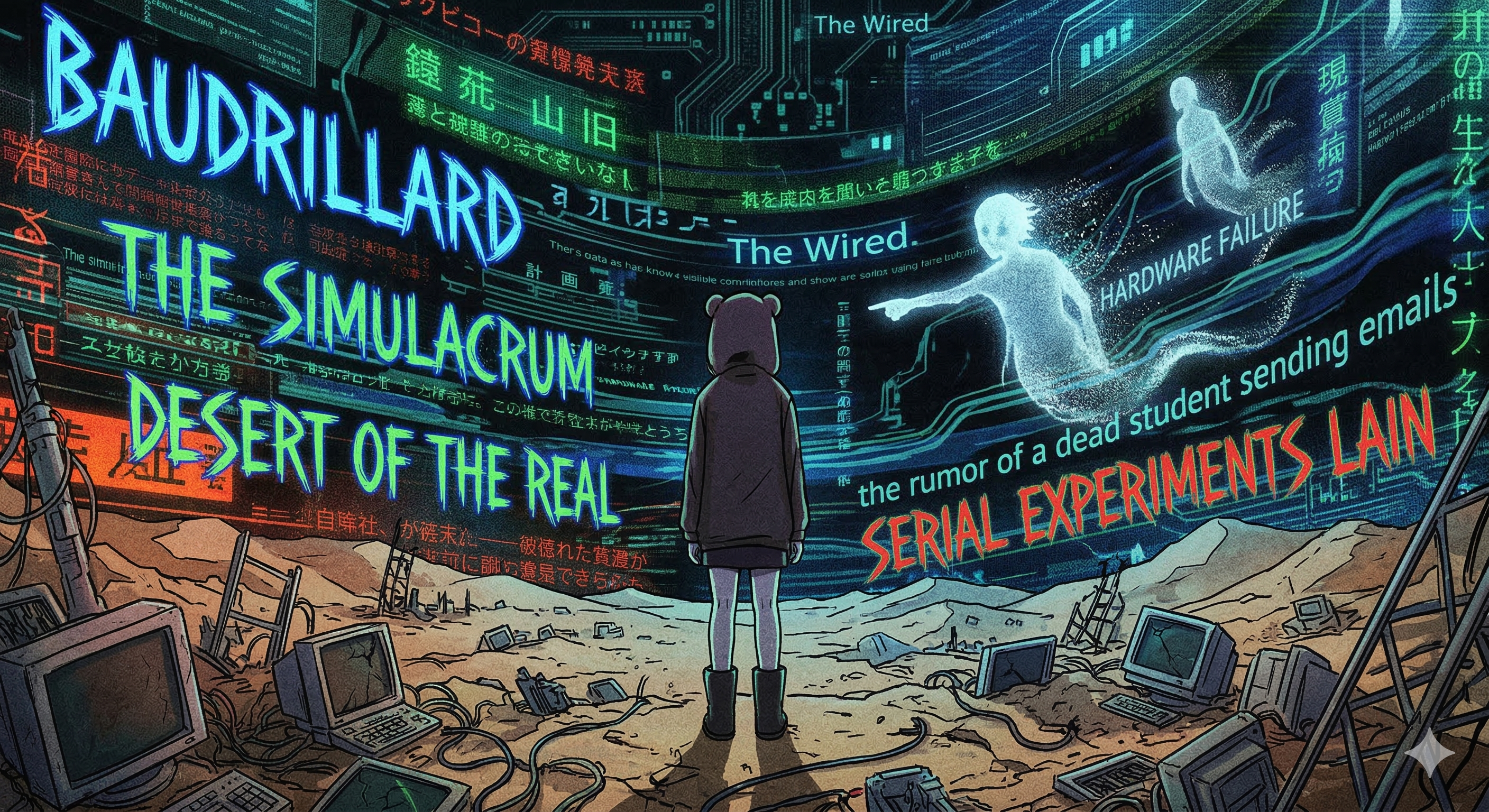
While popular media often utilizes Jean Baudrillard’s concepts to describe a simple distinction between the real and the fake, Serial Experiments Lain applies the structural conclusion of his theory: the precession of simulacra.
Baudrillard posited that in contemporary society, the simulation no longer imitates or even distorts reality; it precedes and dictates it. The real is produced from miniaturized cells, matrices, and memory banks—it is hyperreal.
The Four Stages of the Sign
Baudrillard outlined four successive phases of the image, which can be mapped onto the integration of the Wired into human life.
| Stage | Baudrillard’s Definition | Narrative Manifestation |
|---|---|---|
| First Order | Reflection of a profound reality; the faithful copy. | The Wired as a medium for communication and information transfer. |
| Second Order | Masks and denatures a profound reality; an unfaithful copy. | Online personas begin to distort real-world interactions; the "Other" Lain appears. |
| Third Order | Masks the absence of a profound reality; a copy with no original. | The Wired rewrites memories; the distinction between real and fake becomes meaningless. |
| Fourth Order | Pure simulacrum; no relationship to any reality whatsoever. | The Wired and Real World merge; the physical is a hologram containing the network. |
The series establishes that physical death is an operational glitch in a system where the primary reality is the digital stream. This aligns with Baudrillard’s assertion that society has replaced reality with symbols and signs. When the Wired becomes the primary persistent reality, it renders the biological body a redundant tether. The phrase "the physical world is just a hologram containing the network" serves as the definitive statement of Stage 4 simulacra.
The Integral Reality and the Catastrophe of Perfection
In the Baudrillardian sense, the Wired is not an upper layer to reality; it is the truth that hides the fact that there is no reality. This leads to what Baudrillard called Integral Reality—a closed circuit where all noise and static are expurgated to reach a state of technical perfection. The series portrays this as a radiant perspective that is lived as a catastrophe in slow motion. The catastrophe is not the destruction of the world, but the loss of the real through its perfect simulation.
Masami Eiri, the creator of Protocol 7, seeks to achieve this Integral Reality by uploading his consciousness and encouraging others to do the same. To Eiri, the body is an unnecessary filter that prevents total connectivity. By removing biological noise, humanity enters a state of total equivalency where the distinction between real and fake becomes meaningless—the hallmark of the hyperreal. However, Baudrillard himself famously critiqued The Matrix for making the distinction between the real and the simulation too clear (the red pill vs. the blue pill); Lain more accurately reflects his theory because the characters eventually cannot distinguish which reality is which.
Hauntology and the Aesthetic of the Obsolete
The visual language of the series is rooted in the concept of Hauntology. Popularized by Mark Fisher, hauntology refers to the ghosts of unrealized futures and the persistence of the past in the present. The series does not present a sleek, futuristic vision of technology. Instead, it is filled with the hauntology of the beige box—the CRT monitors, the tangle of wires, the hum of power lines, and the industrial static of the late 20th century.
The Static of Lost Futures
Fisher noted that hauntological art is preoccupied with the way technology materializes memory, often through the use of crackle, surface noise, and the sounds of technologies breaking down. In Lain, the ubiquitous hum of power lines serves as a sonic signature of this hauntological state. It is a reminder of the physical infrastructure required to sustain the digital ether. This hardware evokes a discontinued future rather than historical nostalgia; it represents the failed promise of 20th-century technological optimism.
| Aesthetic Element | Hauntological Significance | Cultural Implication |
|---|---|---|
| Beige Hardware | Residual artifacts of 1990s computing. | The static of a future that never fully arrived. |
| CRT Static | The fuzziness and tremor of the analog image. | A refusal to accept the sterilized digital "Integral Reality". |
| Power Line Hum | The physical presence of the network infrastructure. | The bridge between the "lost imaginary" and the "here and now". |
| Washed-out Palettes | The bleached nature of a world losing its "real" color. | The slow cancellation of the future. |
These artifacts are essential to the critique of the digital age. They represent the materiality of memory in an era that is rapidly moving toward digital ether. By grounding the high-concept dissolution of consciousness in the clunky, oppressive hardware of the late 90s, the series highlights the friction between the biological self and the digital system.
Doomscrolling and the Hyper-Eschatological Condition
Modern interpretations connect this hauntological aesthetic to the contemporary phenomenon of doomscrolling. Doomscrolling is defined as a collective nepenthe, a precautionary measure against the catastrophe of boredom. To be "#Lainpilled" is to move toward a definition of the hyper-eschatological condition—a state of passive nihilism where the individual is aware of the dissolution of reality but remains algorithmically intimate with the system that causes it. The series’ use of fuzziness and tremor in the image is a poetic reversal that challenges the system's demand for total transparency and technical perfection.
The Neurogenetic Network: Jung, Leary, and the Collective Unconscious
Beyond the structural analysis, the series incorporates psychological frameworks, specifically the Jungian concept of the Collective Unconscious. Carl Jung posited that there exists a part of the unconscious mind derived from ancestral memory and experience, common to all humankind. The series treats the Wired not as a new invention, but as a technological manifestation of this pre-existing psychic connection.
Protocol 7 and the Schumann Resonance
The mechanism for this total connectivity is Protocol 7, a system designed by Masami Eiri to link the human brain directly to the Wired without the need for hardware interfaces. This is achieved by exploiting the Schumann Resonance—the electromagnetic frequency of the Earth's atmosphere. By aligning human consciousness with this global frequency, the Wired becomes a Gaia-like living global brain.
| Theoretical Component | Narrative Function | Psychological/Scientific Analog |
|---|---|---|
| Protocol 7 | Elimination of the device interface between worlds. | Direct Neural Interface / Transcendence. |
| Schumann Resonance | The medium for global wireless connection. | The electromagnetic field of consciousness. |
| Eight-Circuit Model | The developmental layers of consciousness. | Timothy Leary’s Neurogenetic Circuit. |
| Memex / Xanadu | Precursors to the Wired’s information structure. | Vannevar Bush / Ted Nelson’s hypertext theories. |
The use of Timothy Leary's Eight-Circuit Model of Consciousness, specifically the seventh circuit (the neurogenetic or morphogenetic circuit), reinforces the idea that the Wired is an evolutionary step. The seventh circuit connects all forms of consciousness through evolution. By making the collective unconscious "conscious," Protocol 7 attempts to merge humanity into a single, unified entity, effectively ending individual ego.
The Shadow and the Tripartite Self
Lain's struggle with identity is portrayed through the manifestation of different "Lains," which can be analyzed as components of the Jungian psyche. The Shadow is an aspect of the unconscious mind comprised of traits that individuals suppress.
- The Physical Ego: The shy, introverted middle-school student who avoids interaction. This version struggles to navigate the complexities of physical interaction in the Real World.
- Lain of the Wired: A confident, robust, and sometimes aggressive persona. This represents the Shadow—the traits suppressed by the physical Lain that find expression in the anonymity and power of the network.
- The Evil/Other Lain: A malicious variant that acts independently, such as spreading rumors about friends. This represents the autonomous nature of the digital proxy once it has been multiplexed by the perceptions of others.
Lain’s realization that she exists "inside all sorts of people" reflects the Jungian idea that the self is not a static entity but a process reflected in the collective. Her godhood arises from her status as the manifestation of this collective unconscious. She is the body of will that has been omnipresent since the Wired became a place.
Conspiracy and Control: The Majestic 12 and Memex
The narrative weaves together historical conspiracy theories and early computer science to ground its abstract themes. References to the Roswell UFO incident and the Majestic 12 suggest that the technology behind the Wired may have extraterrestrial origins or at least be the result of clandestine government projects.
Vannevar Bush and the Augmented Memory
Vannevar Bush, a foundational figure in computing history, is referenced through the concept of the Memex—a library that would augment human memory by cataloging information with associative traits. In the series, Memex serves as a precursor to Protocol 7. Lain functions as a manipulator of memories, capable of accessing and changing the data within the collective unconscious as if it were a digital archive.
| Historical Influence | Role in Lain Universe | Intended Purpose |
|---|---|---|
| Roswell Incident | Debris and survivors provide alien tech base. | Kickstart Memex and Protocol 7 research. |
| Majestic 12 | Secret group of scientists led by Bush. | Documenting and utilizing extraterrestrial tech. |
| Project Xanadu | Ted Nelson's precursor to the World Wide Web. | Influencing the design of the Wired's structure. |
| ECCO | Earth Coincidence Control Office. | Higher powers manipulating global outcomes. |
The inclusion of John C. Lilly, who studied consciousness through sensory deprivation and LSD, further emphasizes the series' interest in the boundaries of the human mind. These references suggest that the Wired is not merely a social network but a project of psychological and evolutionary engineering intended to move humanity toward a new plateau of existence.
Socio-Technical Implications: Connectivity vs. Isolation
The series presents a paradox: as the world becomes more connected, the individual becomes more isolated. Lain’s transition into the Wired is marked by a reluctant march toward digital martyrdom. While she gains god-like powers over time and space, she loses the ability to have authentic, unmediated human relationships.
Digital Depersonalization and Social Media
The series predicted aspects of modern digital life, including the dual nature of identity and the loss of boundaries between self and technology. The fragmentation of the self into multiple avatars mirrors the experience of modern social media users who maintain different personas across platforms. This leads to a state of digital depersonalization, where the version of the self created in digital spaces feels more real or powerful than the physical person.
- Warring Avatars: The Wired is a hellscape of self-serving mythology and catastrophic self-importance.
- The Power of the Network: The web is perfectly equipped to destroy a person on its own terms within its own structures.
- The Addiction of Connectivity: Despite the ruinous quality of the Wired, users cannot unplug; the distinction between online and offline was never real to begin with.
The Role of Alice as the Physical Anchor
The climax involves a confrontation between the digital god Masami Eiri and the physical reality of human emotion, represented by Alice. Alice provides the counter-argument to the dissolution of the self: the physical hug. She asserts that the body is not just software or hardware but a site of warmth, pain, and heartbeat.
The struggle between Lain and Eiri is a struggle over the definition of humanity. Eiri believes that humanity's destiny is to evolve into a unified digital entity. Lain, influenced by her connection to Alice, eventually rejects this totalitarian unity. However, the resolution is bittersweet. To reset the world and protect her friends, Lain must erase herself from their memories. She becomes a ghost in the system—omnipresent but forever separated from the Real World.
Critical Synthesis: The Body as a Symptom of Culture
Lucia Santaella’s work on cyberculture provides a final layer of analysis. In Corpo e Comunicação: Sintoma da Cultura, she explores how the body Today, world is a site of representation and a symptom of broader cultural shifts. Lain’s body becomes a material manifestation of the Wired, and her consciousness is the Wired’s collective (un)conscious.
Transhumanism and the Apocalyptic Discourse
The series sets the stage for questions regarding transhumanism—the technological preservation of human beings. It asks whether immortality is attainable through technology and if we can map our immaterial states of consciousness into a machine. Reality itself enters into an apocalyptic discourse because it can no longer be relied upon to endure due to technological advancements.
The ontological dissolution described is multifaceted: it is the dissolution of the biological body into the network (Haraway), the dissolution of truth into the hyperreal (Baudrillard), the dissolution of the future into hauntological static (Fisher), and the dissolution of the individual ego into the collective unconscious (Jung). The series posits that identity is not a static thing but a process running in multiple places at once.
Terminal Observations on the Networked Self
The structural evolution mentioned in the index is not a purely positive advancement. It is a transformation into a window creature that receives the world through frames and interfaces. The obsolete hardware of the body may be shed, but the resulting entity must grapple with a world where everyone is connected but no one is heard.
Ultimately, Serial Experiments Lain functions as a hallucinatory projection of the digital age. It remains relevant because it accurately diagnosed the psychological symptom of the culture—the feeling that our lives have become all about our technology and that our bodies have become mere conduits for the flow of information. The ontological dissolution is the realization that we no longer reside primarily in our bodies, but in the connections between us. The hum of the wires is the sound of our own collective voice, reflected back through the machine. This persistent hum, the "beige box" hardware, and the flickering screens are the artifacts of a future that arrived differently than we imagined, leaving us as chimeras in a world of pure simulacra.
>> Bibliographic_References.log
- [01] Haraway, D. (1985). A Cyborg Manifesto: Science, Technology, and Socialist-Feminism.
- [02] Baudrillard, J. (1981). Simulacra and Simulation. Éditions Galilée.
- [03] Fisher, M. (2014). Ghosts of My Life: Writings on Depression, Hauntology and Lost Futures. Zero Books.
- [04] Santaella, L. (2004). Corpo e Comunicação: Sintoma da Cultura. Paulus.
- [05] Jung, C. G. (1969). The Archetypes and the Collective Unconscious. Princeton University Press.